Why so many AI initiatives fail
According to the MIT report "The GenAI Divide: State of AI in Business 2025" (Project NANDA: Networked Agents And Decentralized Architecture), 95 percent of companies see no return on investment (ROI) from their generative AI initiatives. At the same time, an estimated 30 to 40 billion US dollars were invested in these very projects in 2025.
In business units, you often hear the resigned remark: "The technology just isn't there yet" or "It's our data." A misconception. Because the problem rarely lies with the technology - it lies with the mindset.


Starting with technology rather than solving concrete problems together with employees wastes your greatest lever: turning your own people into drivers of change and placing investments where they actually have an impact.
This is exactly where Data Thinking comes in: as a mental model, not just another tool.
Where Empathy Meets Precision: The Data Thinking Method
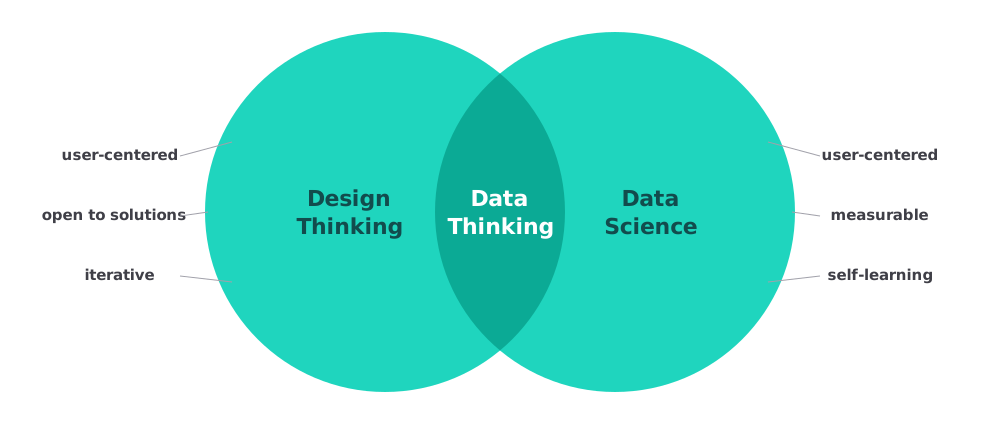
As an implementation method, Data Thinking combines the creative user-centricity of Design Thinking with the concrete solution capabilities of Data Science - consistently focused on one point: creating real value.
Design Thinking: The human-centered lens
Design Thinking is an agile innovation method that consistently puts people first. Rather than starting from technical possibilities, it uses creative, qualitative approaches to deeply understand the real needs and pain points of users. It stands for a radical mindshift: away from rigid plans, toward an iterative process that is open to solutions and in which assumptions are validated through rapid prototyping.
Data Science: The analytical engine
Data Science uses mathematical models and algorithms to generate precise predictions and insights from data. Its goal is measurable optimization: strictly value-driven and designed to create systems that act in a self-learning, self-reinforcing way through continuous data streams. The iterative core of Data Science ensures that predictive quality improves steadily with every data point.
The Three Dimensions of Successful AI Implementation
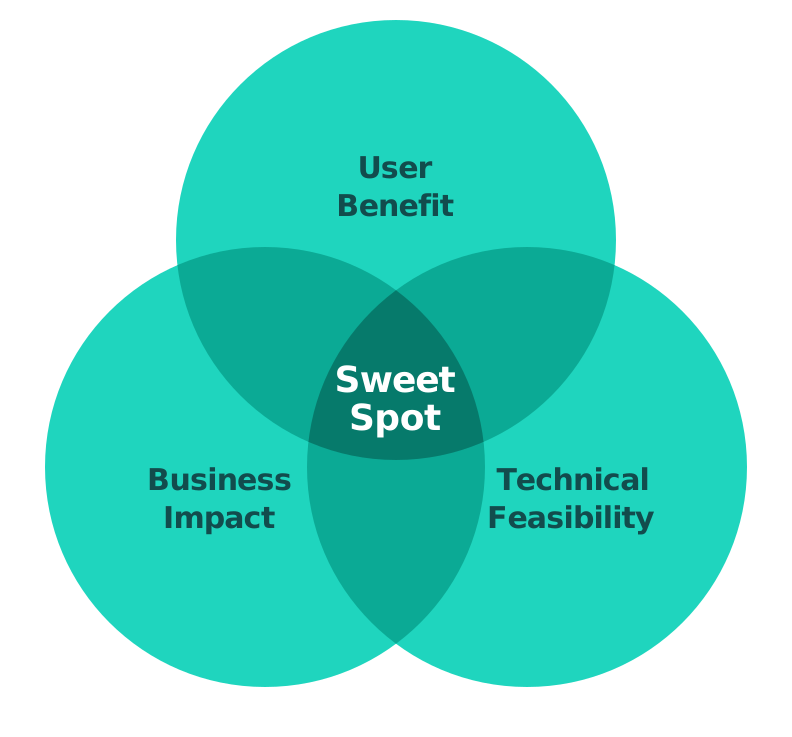
In Data Thinking, the two worlds of Design Thinking and Data Science merge into a new superpower for organizations. The result: solutions that are technically feasible, actually used, and generate measurable business impact. At the intersection of these three dimensions - User Benefit, Business Impact, and Technical Feasibility - lies the potential for real competitive advantage.
User Benefit
A use case only creates value when people actively use the solution - not merely tolerate it. A clearly defined quality threshold is key: only those who know what "good enough" means can work toward it purposefully.
Business Impact
A use case without measurable ROI never gets past the proof of concept. ROI comes from direct savings, but also from better user experiences, leaner processes, or new revenue streams.
Technical Feasibility
Technology is a means, not an end. This dimension clarifies which approach can solve the problem, how the solution fits into existing processes, and on what foundation it can scale safely.
The Origins of Data Thinking
Data Thinking grew out of over 25 years of hands-on experience in data science projects and AI and digital strategy. Marc Weimer-Hablitzel developed the framework and has used it to guide numerous organizations - from startups to DAX corporations - in turning AI into a strategic competitive advantage.
At WHU – Otto Beisheim School of Management, he teaches his Data Thinking method to future leaders as a visiting professor. At Studio Flying Octopus, the method is the starting point of every consulting project - from use-case ideation and strategy to implementation planning.
"Good AI support only emerges close to everyday work."
Marc Weimer-Hablitzel
Use Case Before Technology: The Core Logic of Data Thinking
Data Thinking follows no rigid blueprint, but it does follow a clear pattern: four phases that ideally repeat in cycles.
Data
Thinking
The sequence is: use case first, then business case, then technical feasibility. In practice, this makes a big difference. It means:
- Technology adapts to people, not the other way around.
- Data is not blindly collected - its purpose is defined first.
- Instead of theoretical top-down assumptions, ROI is calculated bottom-up from concrete cases.
As a bonus: an inclusive culture shift that significantly increases employee acceptance of AI.
The 5 Principles of Data Thinking
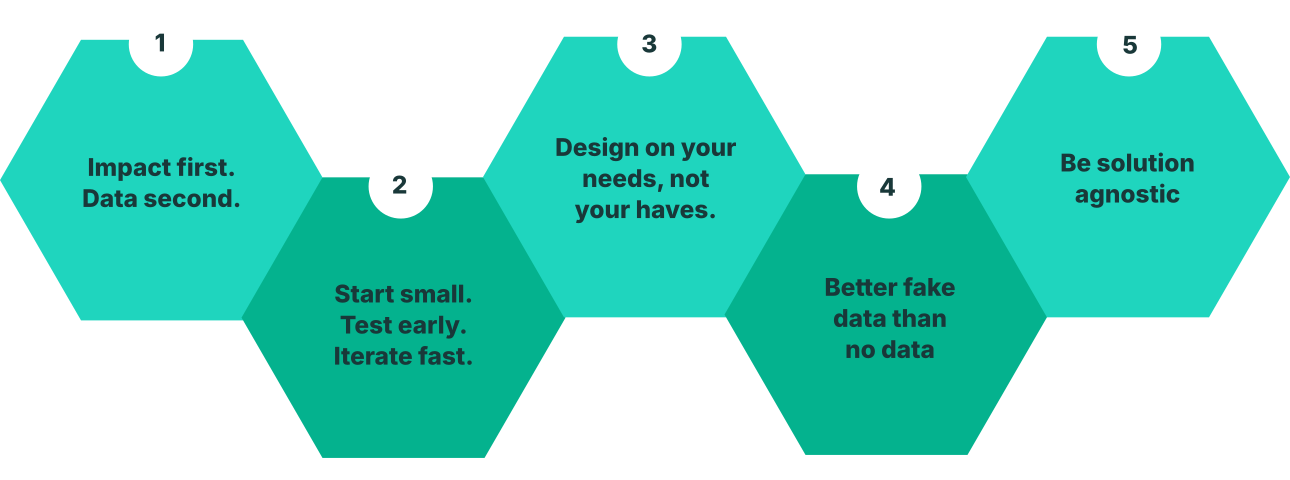
The decisive mindshift - both at the individual and organizational level - rests on five principles:
- 01
Impact First, Data Second
The goal is not determined by the data available - the desired outcome defines what data is needed. Only projects with real value make the leap from proof of concept into everyday work.
- 02
Start Small, Test Early, Iterate Fast
Small test runs validate hypotheses early, generate fast learning loops, and create momentum within the organization through visible wins.
- 03
Design on Needs, not on Haves
Many companies start with the data they have rather than asking what data they would need for a real competitive advantage. Data Thinking reverses this logic.
- 04
Better Fake Data than no Data
The data situation is never perfect - and that is no reason not to start. Synthetic data, assumptions, or simulations make it possible to test a use case early. The right data is built in parallel.
- 05
Be Solution Agnostic
AI is evolving rapidly. Committing too early to a framework or tool means losing flexibility. What matters is which solution addresses the problem most effectively - not what is currently trending.
The Check: Classic IT Logic vs. Data Thinking
But what specifically sets this approach apart from conventional approaches to AI projects?
| Focus |
Classic AI Projects (technology-centric) |
Data Thinking Projects (value-centric) |
|---|---|---|
| Mindset | "The technology and knowledge are there. We just need to implement." | "We learn with the user what is needed and implement what proves itself through concrete value." |
| Starting point | Solution seeks problem: "What can we do with AI or our data?" | Problem seeks solution: "Where is the greatest business potential?" |
| Investment | High risk: Mistakes only surface in costly late phases. | Iterative: Early, continuous testing surfaces missteps before they become expensive. |
| Employees | Resistance: Technology is "imposed" from the top down. | Acceptance: Co-creation - users help build the solution and experience its value. |
| Data approach | Collect data: Gather all data first, then figure out what to do with it. | Design data: Purposefully generate the data needed for concrete value. |
| Outcome | Expensive solutions nobody uses because they are poorly integrated. | Lean tools that show impact from day one. |
When applied correctly, Data Thinking creates more than just small AI solutions. It
anchors a mindset that brings together strategy, technology, and employee needs.
Those who internalize the method don't build isolated applications - they
build a learning, future-ready organization.
Data Thinking for SMEs: Maximum Impact with Minimal Risk
Data Thinking scales from the strategic level down to the specialized AI agent - from broad transformation to a single focused tool. That makes it the ideal method for SMEs: no massive IT capacity required, efficiency as a principle. The early selection process and iterative approach ensure that investment only flows into solutions that have already proven their value in early stages. Projects come in on time, cost-effectively, and with clear metrics.
The application areas are as diverse as the mid-market itself. Three real-world examples:

Identifying new business
The startup Hortiya manufactures plant sensors with GreenBrain AI to make greenhouse cultivation more sustainable and cost-effective. Through Data Thinking, several use cases were identified, iteratively developed, and tested in the market to open up new business areas. The strongest candidate prevailed: an intelligent lighting control system that adjusts artificial lighting in real time to plant needs, maximizing photosynthetic activity.
up to 30% energy savings
Reducing workload in daily operations
S-COM (Sparkassen-Finanzgruppe) applies Data Thinking across the entire value chain of its newsroom to redesign processes and create breathing room for employees. In six months, a series of use cases was implemented and an AI-powered working infrastructure was built together with staff. The range spans from the Ticket Cloner - an automation solution that automatically creates recurring Jira tasks - to intelligent AI agents that accelerate content creation. Entire teams are empowered to use AI in the way that makes most sense for their work.
use cases live in 6 months
Optimizing industrial processes
The SMS Group, a leading manufacturer of steel industry plants, has used Data Thinking to develop new digital products based on existing machine and production data. The group's first AI product was developed from its most successful use case: defect detection in continuous casting lines. The real benefit is a cultural shift away from traditional engineering thinking and toward an iterative process in which the best solution prevails.
the group's first AI productFor mid-market companies in particular, Data Thinking has a decisive advantage: you don't start with a supposedly perfect solution - you start with the concrete problem. Neither a full-scale IT department nor perfect data is a prerequisite. The method works in any industry and any department, with measurable results in three to six months.
Not the Better Tool. The Better Thinking.
- 1
Problem before technology
The success of AI projects is not decided by computing power, but by the mindset. Data Thinking reverses classic IT logic and puts user and value at the center.
- 2
Symbiosis of empathy and analytics
By methodically combining Design Thinking (user-centricity) and Data Science (analytical intelligence), solutions emerge are not only technically feasible but also have high acceptance rates and achieve measurable business impact.
- 3
The "Sweet Spot" of implementation
Sustainable value is only created at the intersection of three dimensions: User Benefit, Business Impact, and Technical Feasibility. Without any one of them, the project stalls at the proof-of-concept stage.
- 4
Culture change through agility
Data Thinking acts as a driver for a learning organization. Following the principle of "Start Small, Iterate Fast," barriers are reduced and employees move from passive bystanders to active shapers of the AI transformation.
Learn more about Data Thinking
In a first call, we'll explore how Data Thinking can be applied in your organization.